Cadaveric Research in Modern Clinical Anatomy: Ethical Standards, Surgical Training and Research Value
Human cadaveric study remains one of the most important foundations of anatomical education, surgical training and clinically applied research. Direct examination of the human body allows students, clinicians and researchers to understand structural depth, tissue relationships, anatomical variation and operative pathways in ways that cannot always be reproduced fully through textbooks, computer models or medical imaging.
At the same time, cadaveric work carries exceptional ethical responsibilities. Human remains are not ordinary teaching materials or laboratory objects. They represent individuals who donated their bodies, or whose remains were otherwise made available under applicable legal and institutional frameworks, for the advancement of education and research.
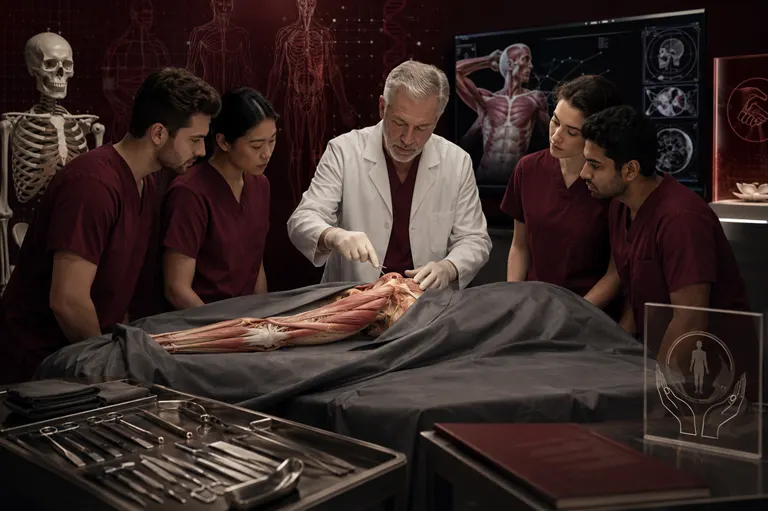
Modern cadaveric research must therefore balance scientific value with donor dignity, consent, accountability, confidentiality and responsible stewardship.
For the International Journal for Clinical Anatomy and Research, cadaveric investigation is especially relevant because it connects gross anatomy with clinical diagnosis, surgical technique, radiological interpretation, medical education and patient safety. High-quality cadaveric studies can clarify anatomical variations, establish safe surgical corridors, improve procedural training and support the development of new clinical methods.
This News & Event article examines the continuing value of cadaveric research, the ethical standards that should govern it and the principles researchers should consider when preparing anatomical studies for publication.
Why Cadaveric Research Still Matters
Digital anatomy platforms, virtual reality, three-dimensional models and advanced imaging have transformed the study of the human body. These technologies offer repeatability, accessibility and interactive visualisation. They are valuable additions to medical education, but they do not eliminate the unique contribution of human cadaveric material.
Direct Three-Dimensional Understanding
Cadaveric dissection allows learners and researchers to examine:
- True anatomical depth
- Tissue layers
- Fascial planes
- Organ relationships
- Neurovascular bundles
- Bone and joint structures
- Tissue texture and resistance
- Anatomical variation
- Surgical access routes
A digital model may display an idealised representation, while a donor reveals the natural complexity of an individual human body.
Exposure to Anatomical Variation
Textbooks commonly present the most frequent anatomical pattern. Cadaveric study shows that arteries, veins, nerves, muscles, tendons, organs and bones may differ considerably between individuals.
These variations can be clinically significant. They may influence diagnosis, regional anaesthesia, vascular access, surgical exposure or image interpretation.
The American Association for Anatomy describes the donor as a potential “first teacher” who allows students to encounter structural differences not always represented in atlases and to develop critical thinking about human diversity. American Association for Anatomy
Understanding Tissue Behaviour
Clinical procedures involve tissue manipulation. Surgeons must understand how fascia separates, how nerves respond to traction, how vessels lie within tissue planes and how joints move.
Cadaveric training can provide tactile and spatial experience that plastic models and virtual systems may not reproduce completely.
Connecting Anatomy with Clinical Practice
Cadaveric research becomes especially valuable when it addresses a defined clinical problem. For example, a study may determine:
- The safest route to a deep structure
- The relationship between a nerve and a surgical landmark
- Variation in arterial branching
- Dimensions relevant to an implant
- The location of a tendon insertion
- A safe zone for needle placement
- The consistency of a radiological landmark
- The likely mechanism of iatrogenic injury
This approach transforms descriptive anatomy into clinically applicable evidence.
The Ethical Foundation of Body Donation
Ethical cadaveric research begins before dissection. It starts with how human remains are obtained, documented, stored and authorised for use.
Voluntary and Informed Consent
Body donation should be based on voluntary and informed consent wherever donation programmes operate.
Potential donors should receive clear information about:
- The purpose of the programme
- Possible educational and research uses
- Whether images may be created
- Whether digital use is possible
- Whether specimens may be retained
- Whether material may be shared
- The anticipated period of use
- Final disposition of remains
- Whether medical records may be accessed
- How confidentiality will be protected
- Whether the donor can withdraw consent before death
- Contact procedures at the time of death
The American Association for Anatomy’s current best-practice recommendations identify informed consent as the foundation of an ethical body-donation programme and call for transparent policies covering registration, custody, use, disposition and memorialisation. Human body donation best practices
Consent Must Be Specific Enough to Be Meaningful
A general statement that a body will be used “for science” may not adequately explain every possible activity.
Modern programmes may involve:
- Undergraduate teaching
- Postgraduate surgical training
- Device testing
- Anatomical research
- Medical photography
- Video recording
- Three-dimensional scanning
- Digital teaching
- International collaboration
- Long-term specimen retention
Institutions should explain which uses are included in consent and seek additional authorisation when a proposed activity falls outside the original agreement.
No Improper Commercialisation
Human remains must not be treated as commercial commodities.
The International Federation of Associations of Anatomists has recommended that there should be no commercialisation in the bequest of human remains for anatomical education and research. Legitimate costs associated with transport, preparation, storage and programme administration may exist, but these should not become trade in human bodies or body parts. IFAA recommendations
Legal Requirements Differ by Jurisdiction
Laws governing body donation, unclaimed bodies, transport, retention, research and disposal vary among countries and states.
Institutions must follow the legislation and regulatory requirements that apply to them. International recommendations are valuable, but they do not replace local law.
Researchers should not assume that material obtained legally in one jurisdiction can automatically be transported or used in another.
Donor Dignity and Respect
Respect for the donor should guide every stage of anatomical work.
Respectful Language
Students, researchers and staff should use professional and respectful terminology. Humorous, careless or objectifying language can undermine donor dignity and the ethical culture of the laboratory.
Responsible Handling
Human remains should be:
- Handled carefully
- Dissected only for authorised purposes
- Stored securely
- Protected from unauthorised access
- Labelled and tracked accurately
- Covered appropriately when not in use
- Disposed of through approved procedures
Professional Laboratory Conduct
Institutions should establish rules concerning:
- Access to the laboratory
- Personal devices
- Photography
- Video recording
- Removal of specimens
- Protective equipment
- Tissue disposal
- Cleaning
- Confidentiality
- Use of images in presentations
- Use on social media
Personal photography should not be permitted merely because a specimen is available in a teaching environment.
Memorial and Gratitude Practices
Many medical institutions organise memorial services, ceremonies or other forms of acknowledgement. These activities can help students understand that anatomical learning is made possible through a profound act of donation.
Such practices should respect cultural and religious diversity and should not reveal donor identity without appropriate permission.
Confidentiality and Donor Identity
A donor’s death does not remove the institution’s ethical responsibility to protect sensitive information.
Identifiable Information
Researchers should avoid publishing:
- Names
- Addresses
- Hospital numbers
- Unique personal details
- Identifiable facial features
- Labels that reveal identity
- Unauthorised medical history
- Images containing identifiable marks
If identity is relevant to a study, the institution should determine whether consent and legal authority permit disclosure.
Medical Records
Access to a donor’s medical records may improve research interpretation, but this access should be covered by consent and institutional approval.
Researchers should collect only the information necessary for the study and protect it through secure data-management procedures.
Images and Digital Media
Digital images can be copied, redistributed and retained indefinitely. Their use creates risks beyond the physical anatomy laboratory.
Before taking or publishing images, researchers should consider:
- Whether imaging was included in consent
- Whether the donor can be identified
- Who will store the files
- Who will have access
- Whether images may be shared online
- Whether external platforms will process them
- How long files will be retained
- Whether images can be withdrawn
- Whether metadata contains identifying details
Educational value does not automatically justify unrestricted digital distribution.
Institutional Oversight and Governance
Ethical cadaveric research requires formal oversight.
Body Donation Programme Governance
A donation programme should have documented procedures for:
- Donor registration
- Consent
- Acceptance or refusal
- Transportation
- Identity verification
- Chain of custody
- Preservation
- Storage
- Allocation
- Research use
- Teaching use
- Specimen retention
- Transfer
- Final disposition
- Family communication
- Incident reporting
Research Ethics Review
Requirements for formal ethics review differ by jurisdiction and institution. Some review bodies may classify deceased human material differently from research involving living participants.
Researchers should not make this determination independently. They should seek a documented decision from the appropriate institutional authority.
A manuscript may need to report:
- Name of the approving or reviewing body
- Approval or reference number
- Consent framework
- Legal source of specimens
- Institutional authorisation
- Waiver or exemption where formally issued
Chain of Custody
Institutions should maintain records showing where each body or specimen is located, how it is being used and who is responsible for it.
This protects donor dignity, research integrity and institutional accountability.
Ethical approval, consent and legal compliance must be established before research begins. Journal acceptance cannot correct an improperly sourced or unauthorised study retrospectively.
Cadaver Preservation Methods
Preservation affects tissue quality, laboratory safety, research validity and suitability for surgical training.
Formalin-Based Embalming
Formalin-based methods are widely used because they provide durable preservation and support long-term dissection.
Advantages may include:
- Extended storage
- Structural stability
- Microbial control
- Suitability for routine anatomical teaching
- Availability for repeated study
Limitations may include:
- Tissue stiffness
- Changes in colour
- Reduced joint mobility
- Altered tissue texture
- Occupational exposure concerns
- Reduced fidelity for some surgical procedures
A research paper should state the preservation method because fixation may affect dimensions, flexibility and appearance.
Fresh-Frozen Cadavers
Fresh-frozen material may provide more realistic tissue handling and joint movement than traditionally embalmed donors.
It can be valuable for:
- Surgical simulation
- Orthopaedic procedures
- Arthroscopy
- Endoscopy
- Device evaluation
- Biomechanical research
- Ultrasound-guided procedures
However, it requires specialised storage, infection-control procedures and careful scheduling.
Soft Embalming
Soft-embalming techniques aim to preserve tissue while maintaining flexibility and more realistic handling characteristics.
These methods may support:
- Surgical training
- Airway procedures
- Laparoscopic practice
- Flap dissection
- Vascular procedures
- Joint manipulation
A 2025 feasibility study described cadaver-based learning as particularly important in surgical fields requiring realistic tissue characteristics. PubMed study
Plastination
Plastinated specimens are durable, dry and useful for demonstrating complex structures. They can support long-term teaching but may be less suitable for procedures requiring realistic tissue movement.
Method Selection
No preservation method is ideal for every purpose. Researchers should select the method according to the question being investigated and disclose its limitations.
Cadaveric Research in Surgical Training
Cadaveric training allows clinicians to learn and practise procedures before performing them on patients.
Practising Operative Approaches
Cadaveric workshops can help trainees understand:
- Skin and fascial layers
- Operative exposure
- Surgical corridors
- Instrument angles
- Neurovascular danger zones
- Tissue separation
- Closure techniques
- Anatomical depth
- Variation
High-Risk and Low-Frequency Procedures
Some procedures are clinically uncommon but technically demanding. Cadaveric training allows repeated preparation for these situations without exposing patients to early learning risks.
Complex Anatomical Regions
Cadaveric training is particularly valuable in regions such as:
- Skull base
- Temporal bone
- Neck
- Axilla
- Brachial plexus
- Spine
- Pelvis
- Hand
- Foot
- Deep abdominal and retroperitoneal spaces
These regions contain closely arranged structures where small errors may have major consequences.
Surgical Innovation
Before a new operative approach is introduced clinically, cadaveric study can help determine:
- Whether the target can be reached
- Which structures are at risk
- Whether instruments can be positioned safely
- Which anatomical landmarks are reliable
- How the approach compares with existing methods
Cadaveric investigation does not replace clinical evidence, but it can provide an important preclinical foundation.
Cadaveric Research and Patient Safety
The ultimate value of clinical anatomy research lies in improving patient care.
Cadaveric studies may help reduce:
- Nerve injury
- Vascular damage
- Incorrect implant placement
- Organ perforation
- Failed regional blocks
- Wrong surgical corridors
- Excessive tissue disruption
- Misidentification of structures
Defining Safe Zones
Researchers may map the distance between a surgical landmark and a vulnerable nerve, vessel or duct. These measurements can support practical recommendations.
A 2025 cadaveric investigation of the obturator nerve, for example, used topographical mapping to support safer pelvic procedures and reduce the possibility of nerve injury. PubMed study
Testing Clinical Landmarks
A landmark described in a textbook may not be equally reliable in every patient. Cadaveric studies can test its consistency, variation and relationship with deeper structures.
Identifying Variations Before They Cause Harm
Anatomical variation research helps clinicians anticipate unusual branching, duplicated structures or variant courses that may complicate surgery and imaging.
Research Questions Suitable for Cadaveric Study
Cadaveric research is most useful when the question genuinely requires direct anatomical investigation.
Suitable areas include:
- Anatomical variation
- Neurovascular relationships
- Surgical corridors
- Morphometry
- Implant placement
- Tendon and ligament anatomy
- Fascial planes
- Joint biomechanics
- Surface-landmark reliability
- Radiological and anatomical correlation
- Procedural simulation
- Device testing
- Surgical education
Researchers should explain why cadaveric material is necessary and why another method cannot answer the question adequately.
Designing a Rigorous Cadaveric Study
Ethical sourcing alone does not guarantee scientific quality. The study must also be methodologically sound.
Define a Clear Research Question
The question should identify:
- Anatomical structure
- Population or specimen group
- Measurement or relationship
- Clinical context
- Intended outcome
A broad objective such as “to study the anatomy of the region” is usually insufficient.
Establish Inclusion and Exclusion Criteria
Researchers should consider excluding specimens with:
- Previous surgery affecting the region
- Major trauma
- Severe deformity
- Pathology that alters anatomy
- Poor preservation
- Incomplete records where essential
- Dissection damage
Criteria should be defined before analysis.
Report Specimen Characteristics
Where available and ethically permissible, report:
- Number of donors or specimens
- Number of sides examined
- Age
- Sex
- Population source
- Relevant medical history
- Preservation method
- Time since preservation
- Laterality
Researchers should distinguish clearly between the number of donors, limbs, organs and observations.
Plan Sample Size Responsibly
Cadaveric research often faces limited specimen availability. Small samples can still provide useful descriptive evidence, especially for rare variations, but conclusions should reflect the sample’s limitations.
A recent methodological paper emphasised that rigour is more important than quantity alone and warned against underpowered subgroup analysis in cadaveric studies. PubMed methodological study
Standardise Dissection
The study should describe:
- Dissection position
- Incision and exposure
- Structures preserved
- Landmarks used
- Instruments
- Measurement points
- Photographing method
- How damaged specimens were handled
Use Reliable Measurements
Measurements should be taken with appropriate calibrated tools. Researchers should report precision and units.
Where possible, more than one observer should evaluate measurements. Intraobserver and interobserver reliability can strengthen the study.
Plan Statistical Analysis
The analysis should match the study design and sample size. It may include:
- Descriptive statistics
- Prevalence
- Mean and standard deviation
- Median and range
- Confidence intervals
- Side comparisons
- Sex comparisons
- Correlation
- Reliability analysis
Subgroup analysis should not be performed when sample numbers are too small to support meaningful interpretation.
Integrating Cadaveric and Imaging Research
Cadaveric dissection and medical imaging provide complementary evidence.
Radiological Correlation
Researchers can compare anatomical findings with:
- Radiography
- CT
- MRI
- Ultrasound
- Angiography
- Micro-CT
This helps determine whether a structure or variation can be detected before surgery.
Imaging-Guided Dissection
Imaging can identify a suspected variant before dissection, enabling focused anatomical investigation.
Validating Imaging Landmarks
Cadaveric studies can test whether a radiological landmark corresponds reliably with the physical structure.
Building Three-Dimensional Models
Imaging and dissection data can be combined to create three-dimensional models for education and surgical planning.
Cadavers, Simulation and Virtual Reality
Cadaveric training and digital simulation should not be treated as competing methods. Each offers different benefits.
Advantages of Cadaveric Training
- Real human variation
- Natural three-dimensional relationships
- Tissue handling
- Procedural realism
- Exposure to unexpected findings
- Professional reflection
Advantages of Digital Simulation
- Repeatable practice
- No tissue degradation
- Immediate reset
- Remote accessibility
- Objective performance tracking
- Scalable distribution
- Visualisation of hidden structures
Advantages of Three-Dimensional Printing
- Patient-specific anatomy
- Repeated rehearsal
- Portable models
- Simplified demonstration
- Planning of complex cases
The most effective curriculum may combine dissection, imaging, simulation, virtual reality and clinical cases rather than relying on one method alone.
Ethical Use of Cadaveric Images in Teaching and Publication
Photography and video can extend the educational value of a dissection, but digital media require careful governance.
Obtain Appropriate Authorisation
Institutions should confirm that donor consent and policy permit image creation and the proposed use.
Remove Identifying Features
Images should be cropped, covered or processed to prevent identification where possible. Labels and metadata should also be reviewed.
Limit Access
Not every image needs to be posted publicly. Teaching material may be restricted to authenticated learners.
The American Association for Anatomy’s Virtual Dissection Database was designed to support education while maintaining donor integrity and anonymity within a controlled digital environment. Virtual Dissection Database
Avoid Social Media Misuse
Images of human remains should not be used for entertainment, personal promotion or casual engagement. Even scientifically accurate content can become unethical when removed from its educational context.
Reporting Cadaveric Research Transparently
A publishable cadaveric manuscript should explain both scientific methods and ethical provenance.
Recommended Ethical Statement
The manuscript should state, as applicable:
- How the bodies or specimens were obtained
- Whether donation was voluntary
- Whether informed consent covered research
- Which institutional body approved or reviewed the study
- Relevant legal or regulatory compliance
- How donor identity was protected
- Whether images were authorised
- How dignity was maintained
Report Preservation and Specimen History
Fixation can alter measurements and tissue behaviour. Authors should not describe findings without identifying the preservation method.
Distinguish Observation from Generalisation
A rare case report should not be presented as a prevalence study. A small sample should not be treated as representative of an entire population.
Discuss Clinical Meaning
Authors should explain:
- Which procedures are affected
- What structure is at risk
- How imaging may detect the finding
- Whether technique should be modified
- What further research is required
IJCAR’s Role in Advancing Ethical Cadaveric Research
The International Journal for Clinical Anatomy and Research provides a relevant platform for studies connecting cadaveric anatomy with clinical medicine.
Suitable submissions may include:
- Gross-anatomy investigations
- Anatomical variation studies
- Surgical-anatomy research
- Morphometric studies
- Neurovascular mapping
- Radiological and cadaveric correlation
- Histological anatomy
- Preservation-method research
- Anatomy-education studies
- Procedural simulation
- Systematic reviews
- Clinically significant case reports
IJCAR’s scope across clinical, gross, developmental, histological and radiological anatomy supports interdisciplinary work involving anatomists, surgeons, radiologists and medical educators.
Authors should consult the latest Aims and Scope, Author Guidelines and ethical policies before submission.
Frequently Asked Questions
What is cadaveric research?
Cadaveric research uses donated human bodies or anatomical specimens to investigate structures, variations, surgical approaches, measurements or educational methods.
Is consent required for cadaveric research?
Requirements depend on the jurisdiction and source of the material. Ethical body-donation programmes are founded on voluntary informed consent, and institutions should confirm that the proposed use falls within the consent provided.
Does cadaveric research require ethics approval?
Requirements differ among institutions and jurisdictions. Researchers should obtain a documented determination from the appropriate ethics or institutional authority before beginning the study.
Why are cadavers still used when virtual anatomy is available?
Cadavers provide real tissue relationships, tactile experience and natural anatomical variation. Virtual tools are valuable supplements but may not reproduce every aspect of human anatomy and tissue handling.
Which preservation method is best for surgical training?
The best method depends on the procedure. Fresh-frozen or soft-embalmed material may provide greater tissue flexibility, while formalin preservation supports longer-term teaching and dissection.
How does cadaveric research improve patient safety?
It helps researchers identify vulnerable structures, define safe surgical corridors, test landmarks and practise procedures without exposing patients to early technical risk.
Can cadaveric images be published?
They may be published only when consent, institutional policy, law and ethical review permit the use. Images should protect donor identity and dignity.
Can body-donation programmes charge fees?
Improper commercialisation of human remains is unethical. Programmes may have legitimate costs for transport, preservation, storage and administration, subject to law and transparent policy.
What information should a cadaveric research paper report?
It should report specimen numbers, donor characteristics where permitted, source, consent, approval, preservation method, dissection procedure, measurements, statistical methods, limitations and clinical relevance.
What cadaveric studies can be submitted to IJCAR?
IJCAR may consider clinically relevant studies involving gross anatomy, surgical anatomy, variation, morphometry, histology, imaging correlation, preservation and medical education, subject to its current guidelines.
Conclusion
Cadaveric research remains a vital part of clinical anatomy, surgical education and patient-safety research. It provides direct access to structural complexity, tissue relationships and anatomical variation while supporting procedural learning and surgical innovation.
Its scientific value, however, depends on ethical legitimacy. Voluntary informed consent, lawful sourcing, institutional oversight, secure custody, confidentiality and respectful final disposition are not administrative details. They are the foundation of public trust in anatomical science.
Researchers must also apply methodological discipline. Specimen characteristics, preservation methods, measurement protocols, imaging correlations and statistical limitations should be reported transparently. Clinical relevance should be explained precisely rather than added as a general statement.
The International Journal for Clinical Anatomy and Research encourages ethically conducted and scientifically rigorous cadaveric research that advances anatomy, surgical practice, medical imaging, education and patient safety. Researchers working in these areas are invited to review IJCAR’s submission requirements and contribute meaningful scholarly work.
Medical institutions or academic societies planning a research journal may explore ScholarJMS for journal websites and editorial workflows, OJSCloud for OJS support, migration and ISSN consulting, GetDOI for Crossref DOI guidance, and Scholar9 for transparent peer-review support. Contact +91 82003 85143 through WhatsApp or email inquiry@ojscloud.com.